Feb 15, 2011

Backwaters

Coconut palms and water hyacinth on the backwaters

Spicy food, shaded waterways, weatherbeaten fishermen and St Joseph's Parish Hall. Born on the bayou? It did feel like Louisiana - until I saw a local taking a bath and brushing his teeth, in the canal. I was definitely still in India, where thousand year old customs collide with the present day, every day.
The backwaters of Kerala, India's lush southwest corner, are a beautiful and fascinating geography. Canals, lakes and rice paddies covering an area bigger than the state of Vermont. A vast, watery web of houses, coconut palms, birds and villages. And boats of every shape and size, from slender old half-sunk canoes to public ferries surging dock to dock. Bobbing in the wake is the trade fleet: fishing boats big and small, propane delivery skiffs and wide, shallow barges hauling sand and stone. Hulking old kettuvallum rice boats, converted into luxury houseboats, do a roaring tourist trade in the wide canals near the regional hub of Alleppy.

Life is lived at the water's edge. People bustle back and forth to town while uniformed schoolkids march along the stone-built banks. Coconuts palms and drooping mango trees dominated the skyline while green thickets of water hyacinth choke the narrower channels. Each house has a set of stone steps leading into the water, where bathing and dish washing take place. Communal wells supply drinking and cooking needs. In the backwaters, schools, stores, temples and restaurants face the bank and boats are the only mode of travel. I spent a day on the canals with a couple of other travelers and a cheerfully buoyant local guide named Saidu.


Adi, the ever-smiling owner of our guesthouse in Alleppy, gave a Spanish girl and me a lift on the back of his Honda down to the docks at eight o'clock in the morning, where we met Saidu and jumped on a battered red and white passenger ferry. It wasn't long until we were out of town, across the lake and into the smaller channels. Breakfast and tea at our guide's house and into a canoe with Saidu at the stern. A wooden boat, 20 feet long, one seat behind the other under a canopy. And the soft, rhythmic sploosh. . . sploosh of Saidu's paddle.

It was a mellow day on the water, sunny and serene, as we toured Saidu's old stomping grounds. Women washed, men paddled and the high voices of children called out. We explored a few villages and survived some mild evangelizing when we stopped at church (to use the bathroom). Lunch was tasty and typical - rice and several sauces, vegetables and pickle served on a smooth green banana leaf. Sitting canalside in the sun, I drank a pale, yeasty glass of coconut beer and dug the scene.

Snack break on the backwaters

The afternoon slipped by, and as I laid back on the cushions my mind began to wander back to the night before. I'd found a small food cart on a dark corner by the beach where a solemn old cook served fresh, crispy-fried chilies with chutney and strong ginger tea. . . We'd played the spice game, a ritual practiced all over the world, anywhere foreigners and hot cuisine collide. I gestured for the chilies and he shook his head no, fanning his open mouth to indicate their heat. In turn, I signaled that I knew, and I liked them. As I chewed the peppers (which were damn hot), everyone gathered at the cart stared and waited. Waited for the sweat, the coughing, the tearing eyes, the cries for water. When I calmly finished my plate and asked for more, there was murmuring, laughter and a tiny smile from the cook: the cultural breakthrough. Little did they know that almost two years of eating in South Korea had burned off my taste buds long ago. An unfair advantage?

As the afternoon light softened, we retraced our steps to town and found ourselves saying goodbye to Saidu on the dock in Alleppy. The roaring, belching bus and high, raspy whine of rickshaws made those hours on the placid water all the more precious, and I thanked our guide warmly. With a few good books and a little coconut beer it would be easy to spend weeks, lost in time, in the green and wet of the backwaters. I turned reluctantly from the canal to catch a rickshaw back to the guesthouse, immediately catching the smiling eye of a waiting driver. It wasn't so bad to be on dry land, I thought as we careened through the streets of Alleppy. There was still enough light for a swim at the beach. And the chili cook would be setting up his cart. . .
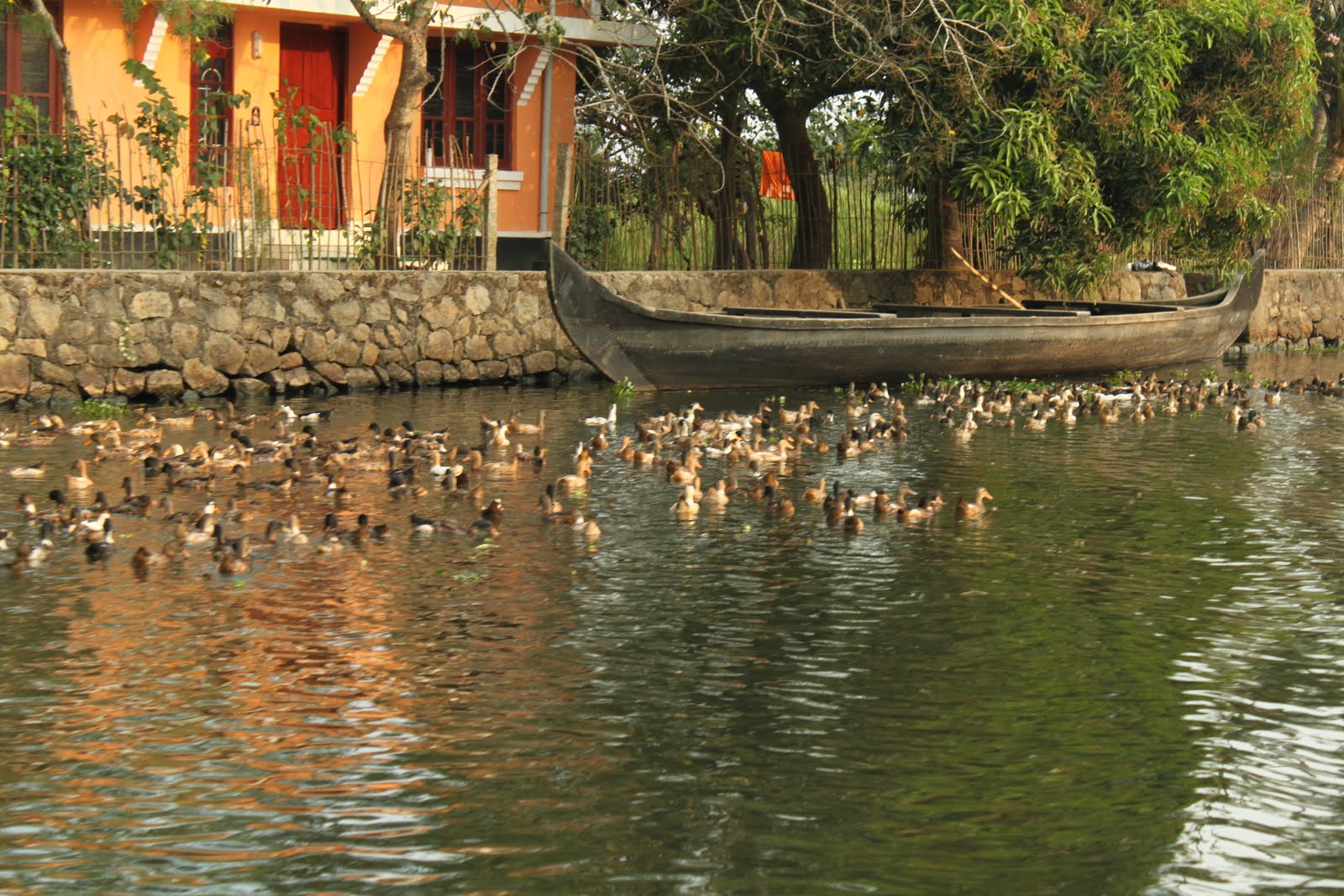

Backwaters homestead


Feb 2, 2011

Madurai Dive Bar

The Green Spot, Madurai


Sometimes I like to play along with a hustle or scam, if the consequences are minimal and outweighed by adventure. That's what happened last night, when I went to a great little 'bar' here in the manic temple town Madurai. At first, I wasn't even going to leave my room for dinner. I'd just gotten back from a long afternoon of visiting Meenakshi Temple, not getting killed in traffic and quality-checking the coffee at three different street stalls. I wasn't that hungry, but after listening to a little ZZ Top on the balcony outside my room I felt like eating meat and drinking beer. I found a tasty chicken biryani in a frantic side street near the hotel and stopped by the 'wine shop' to grab a beer on the way home. Kingfisher, sir? While the guy grabbed a cold bottle from the cooler on the floor, I checked the stock. Five different kinds of brandy and a few cheap whiskeys. Hmm. I paid and we bobbled our heads to conclude the transaction. As so often happens in many parts of India, a smiling young guy with very wavy hair and a red bindi dot on his forehead appeared out of nowhere. Hello friend! Bar, this way! He grabbed my beer and motioned toward a narrow passageway running behind the shelves. I looked at the shopkeeper, who smiled and bobbled his head. I paused for half a second, weighing the options in that filthy, frenetic, fantastic little lane. I could assert myself, take back my beer, and return to my hotel room. Or I could follow this guy down the passage and have some sort of adventure, probably for no more than a few rupees.

I should note that for a country of one billion, there aren't many bars around. Most Muslims and Hindus don't drink, and in general it can be tough to find even a liquor store (not that I look very often.) So to find an actual, authentic little dive is an anthropological goldstrike.

Down the little hallway was a 10 X 15 foot room containing a few tables and plastic stools. The hallway continued, past another little window with more booze to another room. My friend sat me down at one of the tables and asked me what kind of snack I wanted. Aha! As I looked around I realized that this was a kind of hideout, a place where men could drink away from the street, catching a quick buzz before heading off again. Buying a snack was essentially paying a fee to sit and drink out of public view. I didn't want anything to eat, but I said Yeah, sure. Some chicken, whatever. My friend raced away and I sipped my beer, surveying the room. At some point in the distant past, a thick, glossy coat of peach paint had been applied to the concrete walls. This had faded to dirty flesh-tone, where it hadn't peeled away completely. A few flies buzzed under the fans, which weren't doing much to dissipate the heavy heat. The requisite pictures of Hindu dieties hung crookedly in one corner. I shared a head bobble with a gentleman at my table. For some reason he wasn't wearing a shirt or shoes. My smile got wider and wider and I almost started laughing out of pure enjoyment.

The system was this: buy your brandy or maybe a beer out front, come in here, order the mandatory snack, mix your liquor, pound it and scram. Almost everyone that came through had a half-pint bottle of brandy, XXX Shiva and Honiej Day being the most-favored brands. Pour half of the bottle into a plastic cup, fill the rest with water, and don't waste time. Two swallows max. This was no tasting room. You could also be a total badass like another guy at my table, who cut his brandy with beer. Most of the guys looked very unimpressed with the snack they were given, some kind of meat in a unsavory-looking brown sauce. For some reason mine was different - little crispy chunks of something with red onion and lime. It definitely wasn't chicken but I ate a few pieces anyway.

While I sat there drinking in a cloud of bidi smoke, I reminisced about other barsI'd hit on my travels. The crumbling concrete shell in Pondicherry, which looked like an old basketball court with no ceiling, or a possible venue for a steel cage match. The tiny front room in the mountains of Colombia, where I got drunk one afternoon with some local farmers, with a makeshift urinal in the corner of the room behind my chair. The Sealaska Inn, pride of Hyder on the Alaska panhandle, where you can get 'hyderized' by downing a shot of grain alcohol and stumbling around the pool table. And the room tucked away in Quetzaltenango, where upon buying some cheap local firewater, you can save a few pennies by letting the landlady pour it into a plastic bag, saving the bottle fee. Sweet, sweet memories. . .

This post could go on and on but I'll leave it there.

Tamil Traffic Videos

Flow is a verb often used to describe the movement of traffic. In India, where auto rickshaws, motorbikes, bicycles, cars, buses, cycle rickshaws, cows, trucks, tractors and people share the street with tea stalls and a thousand small businesses, it really does flow. When a river encounters a rock, it simply doesn't stop. It changes direction and finds another way. That's how the traffic here works, and the key to safety is simple: commit to your line and keep moving. Whatever is in front of you has right of way. Any hesitation or misstep could be disastrous. Don't turn to look! Just keep going and ignore the cacophony of horns behind you. Because through dozens of bus, jeep and rickshaw rides, as well as navigating the streets myself by motorbike and bicycle, I could count on one hand the number of collisions I've seen. This is a place where barefoot bus drivers blast through crowded markets with inches to spare, all the while leaning on the air horn and maintaining serenely blank expressions. Goats and cows are merely cones on a slalom course, and the concept of lanes exists only in the loosest sense.


At the above intersection in Pondicherry, just check out the scene. It's a 3D mesh. Look ahead, pick a gap and go for it. Somehow it works.


This scene was shot through the window of a bus to Madurai, cruising through the rice country. In the full swing of harvest, the countryside was busy with trucks and carts transporting grain and straw. This video is also a good example that two lanes actually equals (at least) three.


Anyone who enjoys horns should come to India. On any given day in a busy city, you can here approximately 12,000* separate honks. These range from the clack-clack of of a cycle rickshaw's rattled cymbals to deafening blast of bus air horn (which is usually louder inside the bus than out.) In between are a hundred subtle variations: the joy-buzzer rrrr-rrrr of an auto rickshaw; the whonk-whonk of an old-fashioned squeeze bulb; the rising and falling wadada-wadada; and the humble car horn, boring here in such varied company. On this ride in Thanjavur, the rickshaw-wallah uses his simple horn to great effect. Here I come!

*conservative estimate

Bucket Shower

Fill the bucket, take the dipper, pour the water over yourself, etc. . .


The world's smallest school bus.


Street market in Tanjavur at dusk

Three Temples

Walking through the west gopuram of Nataraja Temple
On the last day of January, I woke up in Pondicherry on Tamil Nadu coast. A former French colony, home of the famous Sri Aurobindo ashram and solid tourist stop, it's a good place to have a coffee. After one last cup at Le Cafe on the waterfront, I headed for the bus station. The rickshaw driver asked the most common question: Which country, sir? But after I told him, he started going on and on about his favorite sport: professional wrestling. Not much of a WWF fan myself (or at least since I was 10), my attention wandered and the recitation of ridiculous names was drowned out by 200 honking horns. The bus ride to Chidambaram cut deeper into a vast rice-growing area in southeast Tamil Nadu. Although a few muddy plots stood ready for planting, the harvest was underway. In hundreds of dried-off paddies the crop stood ripe and golden, while in others the rice was being harvested. Machines were at work in some fields while in others, sickles were swinging and stalks threshed against large mats. Lines of people snaked along the channels bearing bunches of straw on their heads. Goats and cows roamed over the stubble. In the shade of a coconut palm, a man tossed grains up and down with a wicker tray, letting the breeze blow the chaff away. Tractors clogged the road pulling wagons filled with bulging sacks.

A long time ago, way back, this part of southern India was the center of the Chola dynasty. The kings built some of the most impressive Hindu temples in all of India, and it was my idea to string a few of these together in a kind of temple hop. The town of Chidambaram was the first stop, home the Nataraja Temple. I was lucky to get a room at the Pari Lodge, in a relatively clean alley and footsteps away from the temple's south gate. Above the gates are stepped towers called gopurams, and as I stood in the lane drinking chai I stared skyward at the astonishing number of colors, designs, and figures. I stopped counting at 40 different statues and estimated there to be over 300 on the whole thing.

Leaving my sandals in my room, I walked down the alley and through the gate, flanked by twin statues of Nandi, the sacred bull and vehicle of Shiva. Hinduism is kind of a long story, but the three main gods are Brahma, Vishnu and Shiva. Most temples are dedicated to the latter two, with the Nataraja Temple no exception. Nataraja is the Lord of the Dance, and one of Shiva's many incarnations.Inside the temple walls the street noise faded away, replaced by the sound of birds and the chanting of puja, prayer. Nataraja is a very open temple, most of the grounds paved with stone, a few overgrown gardens lining the walls and different shrines here and there. The main temple is enclosed in the center of the courtyard. It was powerfully atmospheric, sitting some stone steps at dusk, watching people come and go, looking at the statues, and watching a troop of monkeys clamber up and down the east gopuram.

A man with a small, dark face and a cream-colored shirt sat down next to me, and after a few seconds leaned over. What is your. . . good name sir? The words built up inside him, then whistled out like steam escaping a tea kettle. Enolai and I spoke for a few minutes, and he had the charming habit of squinting his eyes shut as he tried to remember his English, then opening them very wide and shooting his head forward like an owl going whoo! He was from a village nearby, he said, and worked as a mechanic in town. Every evening he stopped by the temple on his way home. He mentioned a dance competition, then shut eyes and seemed to hum to himself. Suddenly, he had it. On May first! While Enolai spoke, I looked over his shoulder at a cow slowly consuming an entire newspaper from a small trash heap.

Enolai borrowed a pen from a large man nearby, wearing a yellow plaid shirt and missing a front tooth. He came over for his pen and started to chat. Your country, sir? Ah, and do you like Obama?
A Malaysian Hindu, he was in Tamil Nadu to visit the ancient temples. And how do you feel? He had a friendly smile and I told him that India was amazing, and a little overwhelming. As a native South Asian, he put things clearly in perspective: Forget the negative! I'm not here to see the negative things. . . He paused and gestured at the thousand-year-old stones. This is magnificent! A useful mantra for the traveler in India. I took it to mean that one can't ignore the suffering and poverty, but can choose where to focus one's attention.

Shortly thereafter a group of priests, preceded by a horn and a drum, bore a large statue of Shiva astride Nandi around the courtyard. Chanting filled the cool air. A monkey ran across the temple roof, silhouetted in the twilight. Small lamps flickered at the shrines as the stars came out. A man bowed and placed prasad at the the feet of a deity carved in stone. To be there, in that place, was to feel something ancient, a continuity of power. At these times I feel the bounds of my atheism stretched, but I settled for a simple feeling of peace and walked back through the gate, bats swooping in the lamplight.


The 180 foot tower of Brihadisvara Temple, Thanjavur
A Nandi shrine inside Meenakshi Temple


Ganesh, Meenakshi

Jan 26, 2011

India: The First 6 Hours


India started on the flight from New York.

There was the obvious excitement and faint smell of incense as I stood on the jetbridge. Boarding the plane, Western concepts of organization, courtesy and personal space were being reordered to Indian standards. I was one of the only white dudes, and starting to feel naked without a neatly-combed part in my hair and jet-black moustache. I couldn't help grinning.

The entire journey had a dream-like quality, leaving the bitter cold of New England and flying east to the Subcontinent via Qatar. We crossed the Arabian peninsula at dusk, vast expanses of desert and mountain glowing rosy pink under fluffy purple clouds. Changing planes in Doha, night on the tarmac was warm and clear. I could smell salt in the humid air. I watched a Bollywood film on the next leg to get in the mood, and the marketplace dance numbers and wailing soundtrack set off a cascade of memories from my first trip to India five years previous.


Jostled off the plane at 3am in Chennai, I shuffled up the ramp and into one of the ugliest airports I've ever seen. The threadbare blue carpet and dirty marble was depressing, and in my rush to get out I squabbled needlessly with the passport control officer. Why is this blank? Address in India? I don't have one. You must have an address. Fill it out! he barked, and shoved the arrival from back across the counter. My brows furrowed, and I simply made one up in front of him. He knew this, but the form being properly filled out, he took it and smiled. Next! 

Outside the terminal I tried not to drown in the stifling heat and unconsciously slipped back into habits learned years before, avoiding eye contact with anyone who might be a taxi driver, travel agent or hotel tout. I drank a coffee, found an ATM and put a strategy together with a friendly airport rep named Deepak. He suggested I take a cab to Thambaram, then a bus down to Mahabalipuram on the coast. Despite the a long line of cabs waiting at the curb, Deepak insisted on calling his friend (who would no doubt give him a little kickback from the fare later.) I allowed this as a little thank you for his help, and waited for his friend to arrive. As Kumar drove me to the bus stop, I started getting a flashback from my first time in India. That trip had also started with a nighttime taxi trip, albeit one that turned into an unwanted tour of squatters' fires, wandering cows and money-changing scams in Delhi. This time I was more relaxed and just took it all in.

The city of Chennai was wrapped in a balmy predawn haze, fuzzy pools of lamplight revealing stray dogs and streetsleepers wrapped in blankets. Gaunt cows grazed on the trash that drifted like snow against fences and buildings. Rickshaw drivers and early risers congregated around the few open tea stalls, standing out in the darkness like bright fountains of milky steam. Waiting at the bus station, I watched the buses careen in and out, headlights swinging and cutting through the dust like light sabers. A few bicycle tea-sellers tried to scare up some business, but the crowd at the stop was a quiet one, and they disappeared again. Smells came and went: cumin seeds popping in hot oil, masala and tea, the acrid sting of burning trash.

Just as I was beginning to doubt Deepak's word, bus 515 pulled to the platform and lurched to a stop. The frowning driver and pudgy conductor, groggily rubbing his face, got off for a quick cup of chai. Soon we pulled away from the crowds as a soft scarlet glow lit the edge of the city. Driving along, I checked out the scene. Crumbling shopfronts spilling commerce into the street. Motorbikes and rickshaws buzzing like bees around a hive. A bullock cart hauling milk. Women filling water containers at communal taps. Before long, we left the city behind and plumes of bamboo and banana overhung the road, then miles and miles of rice paddies. After an hour of flat stretches and small towns, we barreled down the main street of Mahabalipuram, famous for religious stone-carving, old temples and shrine caves. I'd sketched a map of town in my notebook in preparation for finding a guesthouse, but as soon as I stepped off the bus I met a short man with a brown wool hat and a thick salt-and-pepper moustache. "You need a place? Lakshmi Lodge?" I surrendered myself to the path of least resistance, in the form of my new friend and a battered black-and-yellow rickshaw, and we bumped and sputtered down the back lanes toward the beach, toward the Bay of Bengal. Uniformed schoolkids shouting to each other, a man brushing his teeth in the gutter, shopkeepers sweeping and lighting incense, cows nosing trash heaps, people reading newspapers and drinking chai.


A few minutes later, after a lift from my father, three flights, a cab, a bus and a rickshaw, I was showered and sitting in the leafy courtyard, watching crows flap over the roofs in the building heat. I could smell ginger and incense, and somewhere nearby a woman hummed to herself as she hung washing out to dry. Five more weeks. . .

Jan 24, 2011

Melbourne

Sometimes you just want to chill without someone making out right next to you.